

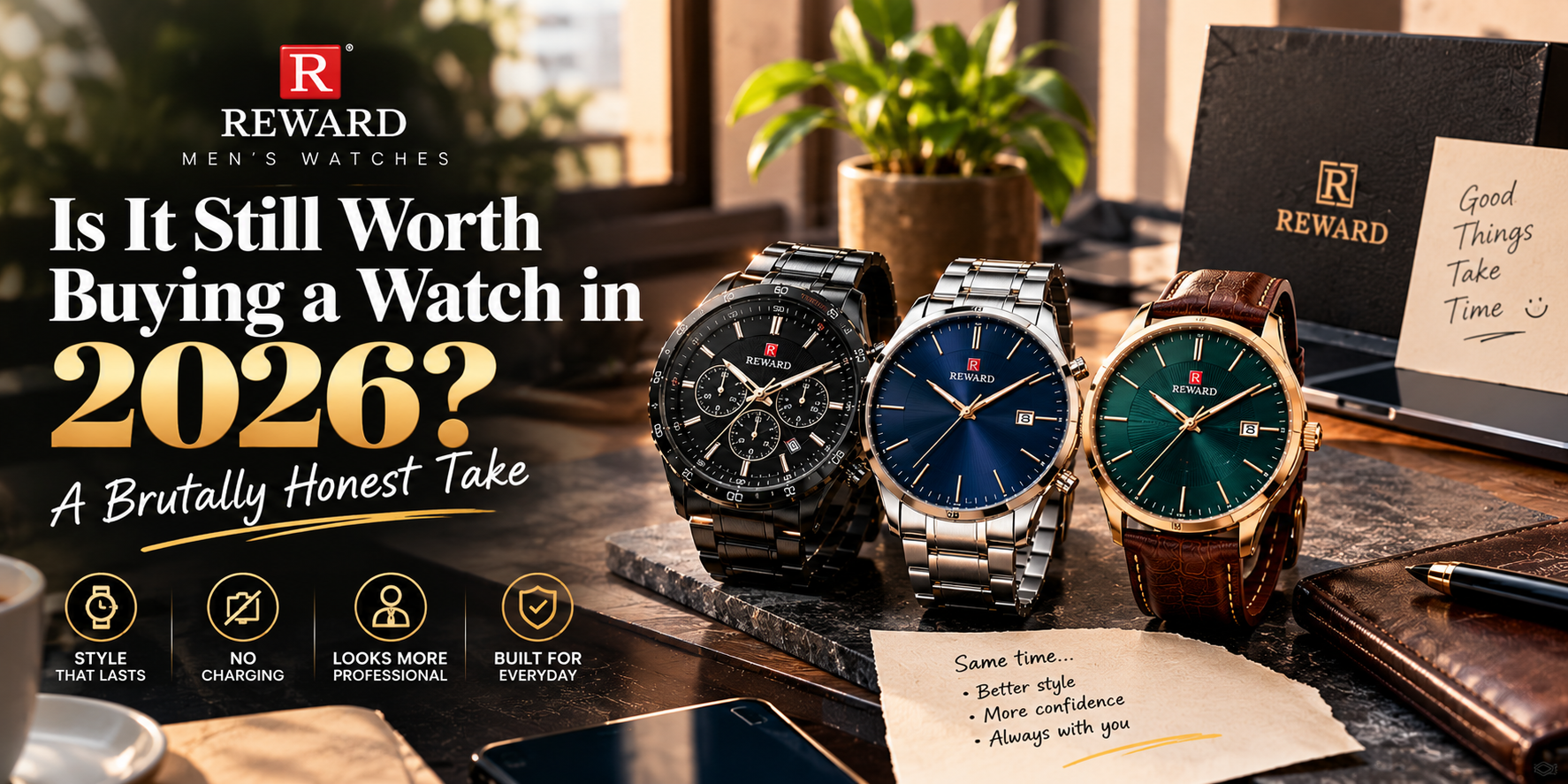
Is It Still Worth Buying a Watch in 2026? A Brutally Honest Take
The Question Nobody Expects to Debate
You pull out your phone at a dinner and check the time. Nobody thinks twice about it. But when someone glances at a well-chosen watch on their wrist — the room notices. That small, wordless signal says something about you that a ₹1-lakh smartphone never will.
Yet the question keeps coming up on Reddit threads, Instagram comments, and WhatsApp groups: "Why would I spend money on a watch when my phone tells the time?" It is a fair question. And the answer goes far deeper than most people expect.
This is not a sales pitch. This is an honest breakdown of when a watch makes sense, when it does not, and why millions of Indian men are still buying them in 2026.
The Smartwatch Killed the Watch — or Did It?
Here is what actually happened. Between 2020 and 2024, budget smartwatch brands like boAt, Noise, and Fire-Boltt flooded the Indian market. Sales skyrocketed. Everyone declared traditional watches dead.
Then something unexpected happened. By 2025, smartwatch return rates in India were climbing. The batteries lasted barely two days. The health sensors were unreliable enough that doctors warned against trusting them for medical decisions. And after 12 to 18 months, most budget smartwatches started lagging, losing features with abandoned app updates, or simply dying.
Meanwhile, a Japanese quartz watch bought in 2020 for ₹2,500 was still running perfectly on its original battery, still looking good, and still getting compliments. The watch never needed a software update. It never needed charging. It just worked — silently, reliably, every single day.
That is the core argument for a traditional watch in one paragraph: it is the only tech you wear that becomes more valuable over time instead of more obsolete.
The Real Reasons People Buy Watches in 2026
It Changes How People Perceive You
This is not vanity — it is psychology. Studies in professional settings consistently show that wearing a watch signals punctuality, attention to detail, and intentionality. In India's job market, where first impressions in interviews and client meetings carry enormous weight, a ₹3,000 watch on your wrist communicates more professionalism than a ₹30,000 phone in your pocket.
Ask any HR manager. When two candidates are equally qualified, the one who looks more "put together" gets the callback. A watch is one of the simplest, most affordable ways to achieve that impression. For the best options at each budget, see our watch buying guide.
It Breaks Your Phone Addiction
The average Indian checks their phone 150 times a day. About 40 of those are just to see the time. But once the screen lights up, you notice a notification. You open Instagram. Twenty minutes vanish.
Wearing a watch eliminates those 40 daily screen activations. That is roughly an hour of recovered focus every day. If you work in a job that requires concentration — coding, writing, studying, designing — a watch is not a luxury. It is a productivity tool that pays for itself within a week.
It Is One of the Few Things Men Can Wear
Indian men have exactly three socially acceptable accessories: a watch, a ring, and maybe a bracelet. That is the list. Women have earrings, necklaces, bangles, anklets, and a dozen other options. Men get a watch.
That limitation is actually a superpower. Because you only have one accessory slot, the watch you choose carries your entire style statement. A clean minimalist dial says something different from a bold chronograph. A leather strap says something different from a steel bracelet. It is personal expression compressed into a 42 mm circle on your wrist. Explore the different styles in our Reward collection and NaviForce collection.
It Lasts — Actually Lasts
A phone becomes "old" in two years. A laptop in four. Shoes in one. But a well-made quartz watch? Five to ten years easily, often longer. The battery costs ₹100 to replace every three years. The rest of the watch just keeps running.
Compare that to a ₹5,000 smartwatch that becomes e-waste in under two years because the company stopped pushing software updates or the battery no longer holds a charge beyond eight hours. The math is brutally simple: a ₹3,000 analog watch over ten years costs you ₹300 per year. A ₹5,000 smartwatch over two years costs you ₹2,500 per year. The "expensive" choice is actually the cheap one.
When a Watch Does NOT Make Sense
Let us be honest about this too.
If you need health tracking, get a smartwatch or a fitness band for that specific purpose. An analog watch will not count your steps or monitor your heart rate. These are different tools for different jobs.
If your budget is under ₹1,000, skip it. At that price point, you are getting genuinely bad watches with movements that die within months and straps that crack. Save up to at least ₹1,500–₹2,000 and get something that will actually last. Our Reward watches under ₹2,000 guide covers the best options at that entry point.
If you genuinely do not care about how you present yourself, and you are at peace with that — fair enough. Not everyone needs to optimise their appearance. But most people reading this article do care, even if they have not thought about it explicitly.
The ₹2,000–₹5,000 Sweet Spot in India
This is the budget range where the value proposition for watches is strongest. Below ₹2,000, options are limited. Above ₹10,000, you enter enthusiast territory where diminishing returns kick in.
But between ₹2,000 and ₹5,000, brands like Reward and NaviForce are producing watches with stainless steel cases, sapphire-coated crystals, Japanese quartz movements, and water resistance — the same specs that mainstream brands charge ₹8,000 to ₹15,000 for. The gap exists because Reward and NaviForce sell direct and skip the multi-layer distributor markup that inflates prices at retail stores.
For a detailed price-by-price breakdown, read our best watches under ₹3,000 guide.
What About Resale Value?
Let us address the elephant in the room. No, a ₹3,000 watch does not appreciate in value. That is a Rolex and Patek Philippe game, and those start at several lakhs.
But that is the wrong way to think about it. A ₹3,000 watch gives you daily utility, professional presence, and personal style for years. By the time you retire it, the cost-per-wear is lower than the cost-per-wear of most shirts in your wardrobe. Nobody asks about the resale value of their favourite pair of jeans. A watch in this range is the same category — a personal item that justifies its price through daily use, not investment returns.
The Social Media Angle Nobody Talks About
Here is something interesting: watch content on Indian Instagram and YouTube has exploded in 2025–2026. Creators reviewing budget watches regularly pull 500K to 2M views per video. The comment sections are filled with young men asking "Where can I buy this?" and "What is the model number?"
Watches are having a cultural moment in India, driven by the same generation that grew up on smartphones. It is a deliberate pushback against screen fatigue — a conscious choice to own something physical, mechanical, and permanent in a world that is increasingly digital and disposable.
If you are reading this article, you are already part of that shift. The question is not whether watches are worth it. The question is which one matches who you are. Start with the full collection and find out.
The Verdict
Buy a watch if you want something that works every day without charging, makes you look sharper in every setting, lasts ten times longer than any gadget at the same price, and gives you a way to express personal style in a world that has made men's fashion almost invisible.
Skip it only if you genuinely have no use for any of those things. But most people, once they try wearing a good watch for a week, never go back to checking their phone.